I recently published my first novel. Here it is in eBook at various stores, or Amazon, including paperback option.
This was begun back in 2022, just after my son turned 3, with the intention of being a book for his fourth birthday. My plan was to sidestep the troublesome planning and writing block that comes with it and just write a super short chapter every few days and see where the story took me. All went well for the first few months, but as I went on, a plan of where the story would go solidified in my mind, and then the writing became harder–I can’t say why that happens with me. It’s like when I know where it should be going, there’s a pressure to ensure things happen according to plan, and an expectation. Well, that’s when I ground to a halt. For his fourth, I quickly threw together a picture book, and promised to finish this for his fifth.
In the meantime, I first self-published a collection of short stories (see previous blog post), then this collection of moral stories for kids. The latter, I also converted it so print copies could be sold, and bought one to read to my son. The print version, unfortunately, was not so nice–slightly misaligned printing gave it a wonky, cheap feel.
Not so with the new book. Below are a couple of pictures. The quality is really nice 🙂
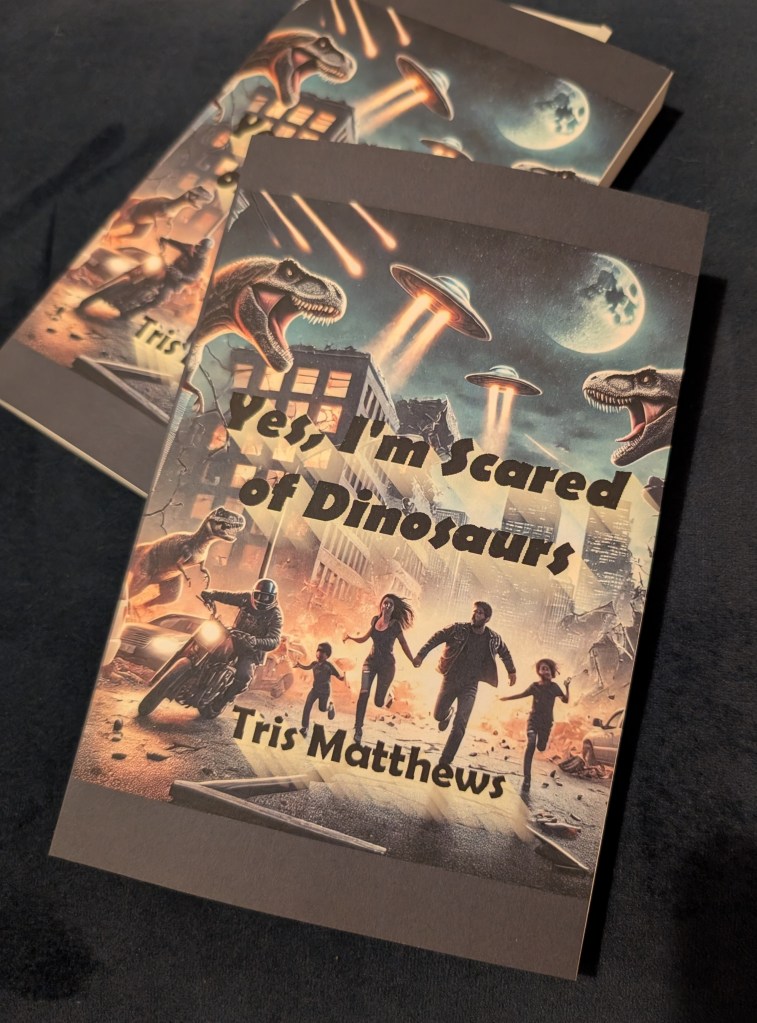

So, on to the process of writing, as it was a little unusual. After getting stuck around half-way through, and leaving it for a year, I needed to find a way to motivate myself to finish. That previous book I mentioned–20 Five-Minute Stories with Morals for Young Children–I made in its entirety using ChatGPT. I created a GPT that would take the age of the child, a set of target vocabulary the child is learning, along with their favourite things, and output a story. If you have a child around 5-8 years old, it’s worth a read. Also, if you are interested in what modern LLMs like ChatGPT can do in terms of story writing, that is a great demonstration.
So I decided I could leverage ChatGPT to help me finish this new book too. However, if you read 20 Five-Minute Stories with Morals for Young Children, you’ll notice certain similarities between stories. There’s always someone’s eyes sparkling in wonder, there’s frequently a treasure the kids find, and much of the language is overly generic. But just because you’re utilising a GPT does not mean the GPT has to do everything. My plan was, then, to give the GPT the chapter outlines, get it to output the chapters, then I’d go over and edit. I built a GPT with this in mind; alas, the resulting chapters suffered from similar issues to those mentioned above.
The process I finally settled upon was working hand-in-hand with ChatGPT to plan out a chapter (this is marvellous as it acts like a person to bounce ideas off, and a slave who’ll do the boring listing, re-listing, re-re-listing, etc), then getting it to write a chapter from the plan that I would completely re-write. Any time I started to get stuck, I could just refer back to the GPT-made chapter to get moving again.
The resulting book is 100 per cent human written, but accelerate by use of the GPT.
Then on to the pictures–my son insisted it have pictures. This is a bother. I’m not an artist, and for the previous picture books I’ve created for him (there are two), the pictures have taken months! For this, I decided to completely rely upon ChatGPT.
Image generation in a Large Language Model comes with its own set of challenges. They are ridiculously bad at consistency of characters from on image to the next. They are also heavily constrained by the images they’ve been trained upon, so you can get them to create really good pictures of T. Rexes doing basically anything as the majority of pictures of dinosaurs are pictures of T. Rexes (I guess), but get them to draw a Carnotaurus or Pterodactyl and they draw… a T. Rex (a flying one, in the latter case)!
My solution was to create a GPT with these instructions: “highly stylized, black and white polygonal aesthetic. The style is characterized by sharp, geometric shapes that form the entire composition, creating a modern and abstract appearance”. And, on top of that, to request pictures that did not focus so much on the characters in the book, but rather on the action that surrounds them. Even within these constraints, the image generation was a nightmare, and took a couple of months after the writing was all finished.
I do, however, rather like the results (though I’m on chapter 8 with my son now and he informs me he doesn’t like the pictures much as they are not colourful). You can see a couple of examples in the picture above.
Finally, what’s to say about the story itself. Well, first up, it’s pretty long–proper (short) novel length of around 50,000 words. It’s about a boy called Morgan who struggles with fear. Unfortunately, attacking aliens fling a virus-infected asteroid at Earth, causing the most dangerous animals in Earth’s history to come back to life, so Morgan really has to overcome his fears! Due to the length of time it took to write (and my son–my muse–growing up over that time), and, I suppose, my natural tendency towards the dark and introspective, the style changes across the book. This initially bothered me, but it actually suited the character development too, so I made no attempt to go back and re-write the beginning to suit the end.
All in all, I’m rather happy with it. Please, go ahead and give it a try.
 Tris Matthews