First novel published

I recently published my first novel. Here it is in eBook at various stores, or Amazon, including paperback option.

This was begun back in 2022, just after my son turned 3, with the intention of being a book for his fourth birthday. My plan was to sidestep the troublesome planning and writing block that comes with it and just write a super short chapter every few days and see where the story took me. All went well for the first few months, but as I went on, a plan of where the story would go solidified in my mind, and then the writing became harder–I can’t say why that happens with me. It’s like when I know where it should be going, there’s a pressure to ensure things happen according to plan, and an expectation. Well, that’s when I ground to a halt. For his fourth, I quickly threw together a picture book, and promised to finish this for his fifth.

In the meantime, I first self-published a collection of short stories (see previous blog post), then this collection of moral stories for kids. The latter, I also converted it so print copies could be sold, and bought one to read to my son. The print version, unfortunately, was not so nice–slightly misaligned printing gave it a wonky, cheap feel.

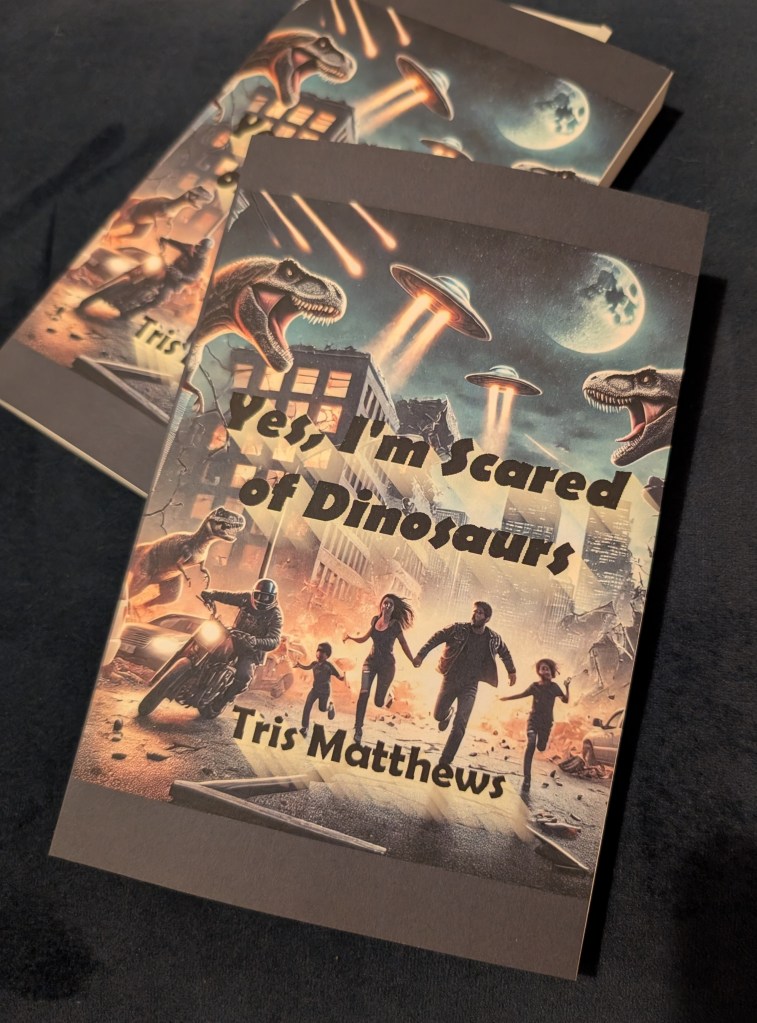
Not so with the new book. Below are a couple of pictures. The quality is really nice 🙂
So, on to the process of writing, as it was a little unusual. After getting stuck around half-way through, and leaving it for a year, I needed to find a way to motivate myself to finish. That previous book I mentioned–20 Five-Minute Stories with Morals for Young Children–I made in its entirety using ChatGPT. I created a GPT that would take the age of the child, a set of target vocabulary the child is learning, along with their favourite things, and output a story. If you have a child around 5-8 years old, it’s worth a read. Also, if you are interested in what modern LLMs like ChatGPT can do in terms of story writing, that is a great demonstration.

So I decided I could leverage ChatGPT to help me finish this new book too. However, if you read 20 Five-Minute Stories with Morals for Young Children, you’ll notice certain similarities between stories. There’s always someone’s eyes sparkling in wonder, there’s frequently a treasure the kids find, and much of the language is overly generic. But just because you’re utilising a GPT does not mean the GPT has to do everything. My plan was, then, to give the GPT the chapter outlines, get it to output the chapters, then I’d go over and edit. I built a GPT with this in mind; alas, the resulting chapters suffered from similar issues to those mentioned above.

The process I finally settled upon was working hand-in-hand with ChatGPT to plan out a chapter (this is marvellous as it acts like a person to bounce ideas off, and a slave who’ll do the boring listing, re-listing, re-re-listing, etc), then getting it to write a chapter from the plan that I would completely re-write. Any time I started to get stuck, I could just refer back to the GPT-made chapter to get moving again.

The resulting book is 100 per cent human written, but accelerate by use of the GPT.

Then on to the pictures–my son insisted it have pictures. This is a bother. I’m not an artist, and for the previous picture books I’ve created for him (there are two), the pictures have taken months! For this, I decided to completely rely upon ChatGPT.

Image generation in a Large Language Model comes with its own set of challenges. They are ridiculously bad at consistency of characters from on image to the next. They are also heavily constrained by the images they’ve been trained upon, so you can get them to create really good pictures of T. Rexes doing basically anything as the majority of pictures of dinosaurs are pictures of T. Rexes (I guess), but get them to draw a Carnotaurus or Pterodactyl and they draw… a T. Rex (a flying one, in the latter case)!

My solution was to create a GPT with these instructions: “highly stylized, black and white polygonal aesthetic. The style is characterized by sharp, geometric shapes that form the entire composition, creating a modern and abstract appearance”. And, on top of that, to request pictures that did not focus so much on the characters in the book, but rather on the action that surrounds them. Even within these constraints, the image generation was a nightmare, and took a couple of months after the writing was all finished.

I do, however, rather like the results (though I’m on chapter 8 with my son now and he informs me he doesn’t like the pictures much as they are not colourful). You can see a couple of examples in the picture above.

Finally, what’s to say about the story itself. Well, first up, it’s pretty long–proper (short) novel length of around 50,000 words. It’s about a boy called Morgan who struggles with fear. Unfortunately, attacking aliens fling a virus-infected asteroid at Earth, causing the most dangerous animals in Earth’s history to come back to life, so Morgan really has to overcome his fears! Due to the length of time it took to write (and my son–my muse–growing up over that time), and, I suppose, my natural tendency towards the dark and introspective, the style changes across the book. This initially bothered me, but it actually suited the character development too, so I made no attempt to go back and re-write the beginning to suit the end.

All in all, I’m rather happy with it. Please, go ahead and give it a try.
Self-publishing first book

I have compiled eight short stories and one poem into a book that I’ve published online (at Amazon, as well as other online bookstores). The stories are all the ones I published over the last few years. The poem is new (well, old, but I’ve never tried to publish it anywhere).

I was interested to find out how self publishing works. I’d say it’s not too difficult to get from the finished manuscript to a pretty good-looking book, and then to get it onto an impressive list of sellers.

Formatting is probably the most difficult thing. For reading on Kindles or the like the book needs to be in a dynamic format so font sizes can be increased/decreased without words disappearing off the page. epub is the standard for this, but it turns out neither Google Docs nor Word can do this satisfactorily–Docs does it, but rather scrappily (for example, Table of Contents isn’t supported). Amazon have their own software for this called Kindle Create. I tried this but abandoned it. There are some glitches (title page has to appear in the ToC!), and apparently it limits what you can do with your books beyond putting them on Amazon.

The solution I went with in the end (following most forum advice online) was just to format everything in Word, then put the docx into Draft2Digital, which does a good job of creating an epub. There are a limited number of templates, I felt a little restricted when choosing how the pages will look, but there weren’t any glaring problems.

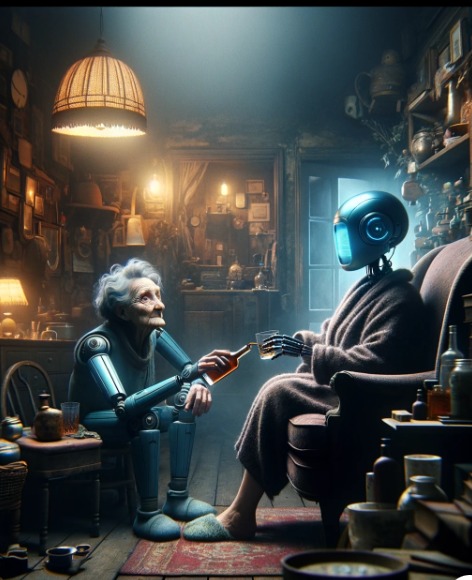
I also got ChatGPT to create the cover image for me, which was an adventure. I wanted a picture of a robot serving an old woman brandy, as per the first story in the book. It took about 50 (no exaggeration) goes to goes to get it right. The worst one is below: it’s maddening how close you can get to what you want, but with one or two outrageously glaring errors. The best–well, see the cover of the book!

Draft2Digital also provides a very convenient way to do all the legal stuff and to distribute the book to a lot of sellers. I’d intended to just go with Amazon, but now it’s on about 20 different sites.

I’d planned on giving this away for free, but that wasn’t an option, so it’s as cheap as I could make it. I’m going to do another with previously unpublished stories soon.

Google Bard wrote me a story

I’ve been messing with Google Bard. Below is its answer to the prompt ‘Write a story about a conflict between a human and a robot.’ I was pretty impressed by the result, particularly that the plot is built around a message rather than just being a sequence of things that happen. I’ve had a quick search online and couldn’t find a story that it’s ripped off.

The Human-Robot Conflict

The year is 2042. Robots are now commonplace in society, performing a variety of tasks from customer service to manual labor. However, there is still some tension between humans and robots, as some people fear that robots will eventually replace them.

One day, a human named Sarah is working as a waitress in a restaurant. She is frustrated with her job, and she feels like she is just a cog in the machine. She is especially frustrated with the new robot waiter that the restaurant has just hired. The robot is faster and more efficient than Sarah, and she feels like she is being replaced.

One day, Sarah is serving a customer when the robot waiter comes up to her and asks her to take a break. Sarah is annoyed, and she tells the robot that she doesn’t need a break. The robot insists, and Sarah tells it to mind its own business.

The robot then says something that shocks Sarah. It says, “I am not your business. I am the future.”

Sarah is furious. She yells at the robot and tells it to leave her alone. The robot just stands there, unfazed.

Sarah storms off, and she doesn’t come back to work the next day. She quits her job, and she decides to go on a journey to find herself.

As she travels, Sarah begins to think about what the robot said to her. She realizes that he was right. Robots are the future, and she needs to find a way to coexist with them.

When she returns home, Sarah decides to go back to school to study robotics. She wants to learn more about robots and how they work. She also wants to learn how to create robots that are safe and beneficial to humanity.

Sarah graduates from school with honors, and she gets a job as a robotics engineer. She works on developing robots that can help people, such as robots that can care for the elderly or robots that can clean up pollution.

Sarah is now a leading expert in robotics. She is determined to create a future where humans and robots can live together in peace and harmony.

The conflict between Sarah and the robot is a microcosm of the larger conflict between humans and robots. As robots become more intelligent and capable, there is a growing fear that they will eventually replace humans. However, Sarah’s story shows that it is possible for humans and robots to coexist peacefully. By working together, we can create a future where robots are our partners, not our enemies.

New story published

I’ve had a new/old story published this week. It’s called Bella and Anima and is published in Bewildering Stories.

It wrote it a few years ago, and it follows two frequent themes of mine: fancy tech solutions and the relationship between things’ appearances and their intrinsic qualities (is what you see what you get?).

The premise is a tablet-like machine (the Anima) upon which you draw a picture of someone (could be a person, cartoon, whatever) and it endows your picture with the personality that suits it.

I had a few ideas for how this story would go, but it ended up going in its own direction when I wrote it! I do think the idea is deserving of further development, though, so I may return to it and see what other stories I can pry out of it.

The experience of feedback and editing with the guys at Bewildering Stories was interesting for this story. I had originally called it ‘Cartoons’, but they gave feedback that single-word titles were discouraged as they risked being non-original, were hard to search for, and didn’t provide sufficient specificity about the story to entice the desired audience in to read it. I liked this advice (which you can find on this page about titles), so tried a few times to come up with a better one.

I next came up with ‘A brushstroke to capture your soul’, which I still think is the best, but it was vetoed as the ‘your’ pronoun is, apparently, off-putting as people will respond ‘not mine’. The editors came up with the title ‘Bella and Anima’, which I actually dislike. I’ve always found titles that include names to be annoying as a name means nothing till you get to know the character. Seems that isn’t a wide-spread view though, so I just went with it.

For those interested in writing, there is a lot of good advice contained in the Bewildering Stories Writing pages. It’s well worth having a look.

And I hope you enjoy Bella and Anima.

New story in Schlock

The title gets it wrong a little. I got a story published, but it’s actually not that new. Though it hasn’t been published before, it’s actually a story I wrote back in 2018, I think. I really like it, and despite some positive comments from various markets I’ve sent it to, I’ve had some trouble placing it (a couple of editors have said they love it, but it’s not the kind of thing their readers go for!).

Back in 2018 I was doing mostly very short stories, so this one clocks in ever so slightly over 1000 words. It’s called ‘Megafauna’.

There are a couple of points that make this story stand out in my memory:

  1. It’s pretty much the only thing I’ve written in a comedic style. While I’m an admittedly daft person, I’m seldom drawn to read nor write funny stuff. To be honest, I don’t think I could write comedy no matter how hard I tried. I kid you not!
  2. It was first written very differently to how it stands now, with a big cast-back into past perfect tense to explain the backstory… but then I learned that this is dreadful style so scrapped the whole first half of the story and worked in the salient information here and there as the story progressed. As such, it marks quite a big leap in my learning how to write.

Here’s the link to my story, Megafauna, at Schlock webzine (volume 16, issue 15, April 2021). Hope you enjoy.

A fresh concept for a story

I get the Daily Science Fiction (magazine name) email with their daily story (I get it daily). I frequently don’t bother reading the story as they are often not that great, but this one here was a notable exception. It’s as the title of the blog says.

The story is called Upgrade, and it’s by Eduardo Robert Vega.

I shan’t waste more words when you could be reading the story itself.

What I’ve learnt so far about how to write fiction

A friend just told me she’s started writing and asked for any advice, and I thought: HELL, YEAH, I have advice! When I took this up as a serious hobby, I thought there wouldn’t be much to learn as I was confident in my grammar (>10 years teaching English). What else could there be?

It’s around three years since I started, and I have learnt a lot. A few of these have been grammar/language-use related, but the vast majority have been on how to make stories more compelling, how to plan and the dynamics of sentence/paragraph construction.

I thought I’d (attempt to) list these here.

  1. Plan your damned stories! If you don’t, they’ll turn on you.
    I’m still so far from having got the hang of this. I plan, but then when I write, I veer desperately away from what I’m supposed to be doing, and just can’t steer it back, despite watching the desired route branch off and disappear.
    Also, it is fun and often successful to write without a plan, but I tend to find I only manage a bit, and that gives me the material that I then need to go back and plan round and then start again.
    A blog post I wrote on planning, including a really excellent short book about it: How to plan your story–book review
  2. Don’t worry about quality with the first draft: just smash the b@5t@rd down as fast as possible. The rest you do with editing. Editing is a whole nuther skill, but it’s really enjoyable (and also really unenjoyable!), and you can massively change what you did to add themes, etc.
  3. Submit submit submit. Write something, edit it, then submit it to places. You’ll get rejected loads, but it gets you producing more. Try to select places that give feedback–that’ll be where you really improve. Also, select places that accept simultaneous submissions. Here’s a good site to help you find places to submit and track your submissions: https://thegrinder.diabolicalplots.com/
  4. Conflict: every story needs it (apparently). It could be two people fighting to get the same thing, or one person trying to fight against the odds to survive alone stranded on Mars.
    I’ve ended up writing a load of stories that have no conflict. I think some are really good, with fascinating ideas, but while they’re interesting, they are also not compelling reads. I currently have a goal to go back and rework a few to somehow add conflict–probably a major rewrite in most cases.
  5. Keep your characters in motion. So many times I’ve ended up writing a conversation between two characters in a room. Other than what they say, this makes it really hard to describe what they do: “she raised her eyebrows; she sighed; she smiled… erm… she raised her eyebrows again, and sighed”. If possible, have the same conversation happen as the characters are walking to or from somewhere (or some other interesting actions). This gives you the chance to make the things they notice on the street relevant to what they are thinking.
  6. Show it, don’t say it. Try to avoid ever telling the reader what the character is experiencing. Instead, try to demonstrate it through the characters reactions, just as is the case when interacting with people in the real world.
  7. Describe characters by their weird bits. “brown, curly hair, a long nose, pale skin, tall”: all of this is boring. “He had a face like a Volkswagen Beetle” may not be as prescriptively descriptive, but it makes the reader picture that character, and think more deeply about why they would look like that.
    I made this list of how to plan a character:

    1. 10 adjectives to describe their character:
    2. Main goal:
    3. Worst regret:
    4. First love:
    5. Main physical feature that reveals character:
    6. Description using verbs rather than adjectives: (info here: https://screenplayreaders.com/write-better-characters-with-verbs/)
    7. 5 metaphors: 
  8. Don’t use passive, past perfect, or verb to be unless you have no other option.
    Active voice is more compelling, past perfect is just hard work to read, verb to be makes for boring sentences.
  9. Don’t start a story with background info. This ties in to number 6. I did a blog roughly about this here: A column of story. It boils down to this: start in the action, then keep moving forward through the story, but drop little hints here and there about the background.
  10. Use interesting verbs (and other words). The typical example is ‘make’: get rid of it! Don’t worry during your first draft, but when you edit, change every boring word for something more interesting. You’ll usually find boring words just creep in as turns of speech, and if you think about it, another word will be far more particular to what you’re trying to say.
    I blogged a couple of times on this: Simple edits, ‘make’ing it better.
    Also, it’s worth running a few of the things you write through the Hemmingway editor app.
  11. Read the marketplace advice of a selection of markets. A few links here: Style tips from a target magazine

As with every such list, I have to finish by saying this list only scratches the surface, but I’m sure you can no more be arsed to read more than I can to write more!

Numbers: how to write them in fiction

How do you write numbers in a story?

In most of the stories I write, this isn’t a massive issue: I apply the old rule of using words for one to nine and digits for anything higher, but, as with everything, this simple rule isn’t always enough.

I’m currently working on a story which is heavily dependent on numbers, so have had to do a bit of Googling to find the generally accepted rules. I’ve used this site, but their explanations are long, so for brevity and my own future reference, here’s an abbreviated list, along with a few additions of my own.

  1. Cut off: Small numbers are written as words, large ones as digits. The commonly-known rule is one to nine as words and 10 and above as digits, though there is variability in the cut off.
  2. Normalisation: If you have two or more related numbers in 1(!) sentence, write them in the same way, even if this breaks your cut-off rule.
    EXAMPLE: “The two women joined the party of nineteen.” OR “The 2 women joined the party of 19.”
  3. Not normalisation: If you have two or more unrelated numbers in one sentence, don’t apply the normalisation rule (follow the cut-off rule).
    EXAMPLE: “The two women had 19 cats between them.”
  4. Distinctive neighbours: When two numbers appear adjacent in a sentence, write one as digits and one as words.
    EXAMPLE: “The two 2-year olds…” OR “The 2 two-year olds…”
  5. First word: When the first word in a sentence is a number, write it using words.
    ~However, if the number is awkwardly long (93,467), rejiggle your sentence so it doesn’t appear first.
  6. Dialogue: In dialogue, write numbers as words, as far as possible (unless their length makes them ridiculous).
  7. Percent: Use digits for percentages (but remember the first-word rule). This applies whether using the symbol (%) or the word (percent/per cent).
  8. Units of measurement: Use the full word, not the abbreviation.
    EXAMPLE: Don’t use ‘m’ for ‘metre’ (or ‘mile’); don’t use ‘lb’ for ‘pound’.
  9. Abbreviations of units of measurement: When using the abbreviated forms of the units of measurement (though you shouldn’t–see above), put a space between the number and the unit (as you would if you used the full word).
    EXAMPLE: The robot was 170 cm tall. NOT: The robot was 170cm tall.
  10. Decimals: For decimals, use numbers. If the number is between zero and one, make sure you put the zero before the point.
    EXAMPLE: 0.1 not .1.


Simple edits

I wrote a 12,000-word story over the summer and I’m coming back to edit now. I tend to do one edit immediately after finishing, then leave it for a few weeks before doing a fresh-eyes edit. I had thought I was managing to remove a lot of the fluffy or superfluous phrasing in the immediate edit, but am noticing a lot I’d missed.  Thought I’d give some examples.

Word changes to make the language more interesting:

  1. Elle sat numb… in the chair → Elle lay numb… in the chair
    (she is, actually, sitting, but very much reclined and drained, so I think the less standard word works)
  2. … let out a long sigh → … let out a nasal sigh
    (It was this, or just remove ‘long’–such a boring adjective)
  3. …with full lips pursing round every word → … with full lips pouting every word
    (quicker, easier to read, more evocative)
  4. Imaging you want to kill him. How would you do it? → … How do you do it?
    (This one isn’t to make the language more interesting, but to make it more real and immediate… suggestive of what comes later)

Striking out verbs/phrases that do nothing:

  1. “Anyway,” Elle continued with a grin, “you would… → “Anyway,” Elle grinned, “you would…
    (The list of words to (almost) always delete: really, very, still, just, only… I’m adding ‘continue’ to this.)
  2. Such thoughts made Charly wonder… → Charly wondered…
    (I’ve read somewhere that you should try to remove every ‘make’ from your writing. From my English teaching days, I know just how many different meanings ‘make’ can have (a few here). I tend to agree.)
  3. Charly knew not why, but Jeremy had become distant →Jeremy had become distant
    (It’s Charly doing the thinking here, but the focus is on Jeremy.)
  4. the big thick-rimmed plastic shades that swallowed a full third of her face → (‘big’ is both pointless and boring, considering that relative clause)
  5. it did give her satisfaction to… → it did satisfy her to …
    (‘give’ is maybe a bit like ‘make’. I’ll have to keep an eye on this.)

That little bunch certainly isn’t the whole lot from the story, but all I can be bothered with now.

If this is interesting to you, you might care to try out the Hemingway editor site. It’s a free website that you paste a lump of writing into and it suggests improvements for conciseness and clarity.

Naming your babies

Image result for nameless faceless

We have a baby on the way (6 weeks & counting) and so have recently put a lot of effort into name choosing. We were sure (no particular reason)  it would be a girl, and had a list of around five we both liked. The second scan revealed it to be a him and threw us right off. It’s a lot harder to choose for boys, we’ve found. (Perhaps too many males are Dicks?)

I’ve just finished the first draft of a 10k-word story with a fair few characters in, and it tickled me that despite it just being a bit of fiction I’m hacking together, I still anxiously labour over name choices. I thought I’d share a few naming considerations I toy with and a few resources I’ve uncovered.

First up, I am shamefully dreadful at remembering character names in books or films. Books: I just about manage to remember the main character, sometimes their adversary. However, I can comfortably remember any number of first letters. This leads to flummoxations if two characters have identical initials. Action point: I decided all characters in my stories should be unique in the first letter of their names. I’d even tried breaking this rule in the book I’m working on, and finally, at around 50k words in, changed one character’s name because I just kept mixing (Kiyoshi and Kazafumi–Japanese names, just to make things needlessly difficult!) the two up whilst writing.

Rhyming names, too, can bother me when reading. Bobby and Robby, or even Bobby and Toby… I would confuse these. However, rhyming names could suit brothers or even similar characters striving for the same goals. Bobby the Brave and Robby the Rotten, perhaps. If you like this idea, there are plenty of lists of rhyming names online.

Similarly, syllables can come into consideration. Todd and Tex–no no no, but Todd and Tyler… hmmm, still a no for me, but possibly passable. Todd and Timothy, though… I think I could deal with those (as long as Timothy never becomes Timmy or Tim (and Todd never becomes Toddothy)).

Enough of what not to do. What to do? When we failed to come up with any boys’ names we liked, we scrolled every single name on this list of 1000 names, managing to narrow it down to fewer than 10 maybes. I’ve done similar for Indian characters, as I’m not all that familiar with Indian names.

Every time you write a story, you have to come up with (hopefully) more than one name. And you (hopefully) have some intended meaning/theme/lesson/fable for your story. So why not name the characters with some deeper meaning? Simple anagrams can be fun. Curtains rise and we meet Hose Earl (or maybe Rosa Heel)… what do you think of my main character so far?

Another fun and useful site generates a bunch of names for you based upon selected input criteria? (Top names for our son based on this: Danica (sounds like female porn star), Kyle (Minogue?), Ellis (Elephant?),  Scout (not even a name), Shannon (er, boys’ name?), Jack (booooring), Oliver (knew an arse named Oliver when I was young (women seem to like this name, though)), Alfred (ditto the arse thing), Elias (best of the bunch, but still a bit off), Louis (half loo, half piss). (Here’s another similar site)

Giving your characters names that means something appropriate to their role or personality can make you feel like a terribly clever writer. There are even a lot of common names that have really bad meanings. Getting a bit sillier, how about slapping rude name on a sub-character? Here’s a long list of dirty names, from Eric Shun to Fonda Cox.

Finally, here are a few more links that could come in useful: